

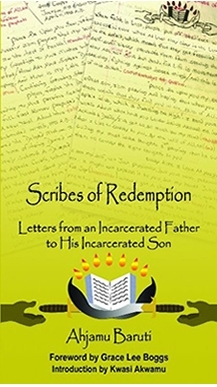
 Life is funny like that: the road we take, Serling’s signpost ahead, the mis-directed arrow with no GPS capability, point indiscriminately missed. This is it – the lesson – deeply imbedded in Ahjamu Baruti’s collected notes, Scribe’s of Redemption: Letters from an Incarcerated Father to His Incarcerated Son. Baruti’s letters are passionate and profoundly insightful; his sociopolitical observations pensive and intellectual, tender and sharp. He is a scholar, legal student, theologian-of-sorts, who could have achieved many great accomplishments if life had only spun a tougher web…if only the sacred geometry of chance had been less mathematical; if the signpost, perhaps, had been a little less blurred. But Baruti’s no victim (nor does he claim to be), and Scribe’s is nobody’s protest novel, but Bigger’s last rant. By the end of this book we come to realize that Baruti’s search for redemption places him right back on the same beaten path, with incandescent letters post-marked with revolutionary stamps.
Scribes is essentially a book of letters from a father to a son, both incarcerated (eventually at the same prison facility). Over several years, Baruti corresponds with his long-lost son, Joseph (he eventually changes his name to Yusef Shakur), and the two gradually get to know each other, share thoughts and ideas, and attempt to change from their previous lives as hardened criminals. Baruti’s letters are gentle, fatherly and instructive. He dispenses multi-level spiritual advice, encourages his son in the ways of mental and physical discipline, navigating him through a tumultuous experience of penal system life, and how to stay alive amidst an unfamiliar backdrop of licentious criminals and corrupt officials. At one point during the exchange, Baruti even suggests that the incarceration of his son is a blessing-in-disguise:
I know that everything happens for a reason so, by you coming to prison, was for a reason which you might not be able to comprehend because of being a finite man. If you were still on the streets (gang banging with your Zone 8 crew), what would you be doing with your young life? Son, the dark reality is that you probably would be dead or probably would be in prison with a much harsher sentence” (62).
The book has a nice temporal flow, chronological in order, which makes the reading easy and smooth. However, I did not understand why Yusef’s letters were not included in the book. At times, Baruti’s correspondence lacked connectivity because we do not feel the emotional engagement between the two, which would certainly help us to feel the interpersonal dynamics on another level. Baruti lays bear his heart and soul in the mental embracement but we do not get to see the responses from his son, only brief allusions and fragmentary glimpses. As a result of this aesthetic defect, we are left to imagine and assume what Baruti is dealing with regarding his son’s imprisonment, their eventual reunion, and we observe the psychological, spiritual,and mental transformation of his incarcerated son.
Yet, Baruti wastes no time being angry and resentful, he doesn’t “hate whitey” (passively acknowledges John Brown’s great sacrifice at Harper’s Ferry), and his diatribes are well-informed, prescient, powerful, august, and commands respect. He is a voracious reader and a bona fide scholar, indeed, possessed of an inter-disciplinary range of topical knowledge on African-American history, African religion, theology, law, holistic health, and physical fitness (his daily exercise program consists of 1000 push ups and he is an exceptional distant runner). Most impressive is his critical insight on the Nation of Islam, and his scholarly approach to understanding the world around him bespeaks a graduate school level frame of mind: “If a brother don’t have any source (books, material, etc) to give support to his claims during a discussion, then it only becomes his own opinion of the matter, not a fact, because we all have opinions about different things in life, but that don’t make it the truth, just an opinion!” In short, Baruti could easily have become a college professor. (When he gets released from prison, he could make a generous living on the lecture circuit, as well.)
Reflectively, I thought about how Baruti’s book entered into the larger dialogue and discourses on the subject of African-American men and the penal system. Books such as Tookie William’s Blue Rage, Black Redemption: A Memoir, Angela Davis’s Are Prisons Obsolete and Mumia Abu-Jamal’s Live From Death Row all make lasting and critical contributions to the pervasive discussions on African-American men and the industrial prison complex. Likewise, Scribes of Redemption would make a great addition to any college-level syllabus, particularly those courses examining prison ideologies and radicalism. For instance, a friend of mine recently taught a course at Michigan State University called Writing: Radicalism, Prison Ideologies & Social Death. The course description stated:
Through critical writing and invigorating classroom discussions we will explore the psychic, social and political effects of prison life, race and prison culture throughout the 20th/21st century. Although much of the required readings center around the voices and lives of African-American men, our focus is primarily directed toward discussing, exploring and responding to the radical notion that we must do away with prisons all together. Additionally, we will explore better ways to appease justice upon a human body, we will pay close attention to the psychological alienation of prisoners, state-sanctioned violence, racial terror, death-bound subjectivity and interracial violence. We will be most concerned with the systematic effects of structures of power which shape behaviors, beliefs, values and racial ideologies. By focusing on prison life we will produce a context for reimagining the possibilities of what it actually means to be human and free in the 21st century. (L. Faulk, WRA 130, MSU/Spring 2010)
Baruti’s book could certainly fit well into any academic course interested in prison literacies. It is a valuable read and no serious scholar can deny its efficacy and validity. But Baruti’s book has issues, too. At times Baruti’s hubris insinuates a connection to Malcolm X and George Jackson, suggesting some sort of validation of Baruti’s life experiences (particularly his time behind bars). Baruti often mentions the “struggle” and the “war” (all of his letter’s end with “peace and love in a time of war”), but he stumbles to define what the struggle is in THIS current social context – but this makes us dig deeper into the text to pull back the layers. Baruti labels himself a political prisoner (“I am a ‘political prisoner’ convicted of this damned falsehood because of my religious beliefs”), as if to juxtaposition himself along the likes of Jackson and Nat Turner. But their stories are different, and perhaps Baruti’s reason for being imprisoned has no correlation to why Turner was executed, or why Jackson was imprisoned. Turner was certainly a political prisoner, and Jackson murdered a white cop in retaliation for the cold-blooded killings of 3 black inmates. Baruti was convicted of armed robbery with assault, and a murder rap of an Aryan inmate. So, at times, Baruti is misleading and confusing. Scribes struggles to move beyond the Old Guard rhetoric of his heroes Nat Turner, Malcolm X, Amos Wilson, M. L. King, Jr., and the legendary revolutionary, George Jackson. Yet, Baruti knows the struggle has changed, and Scribes triumphantly moves beyond it’s interior message to deliver a programmatic lesson for – not just his son but – young black men who may find themselves in the same situation as Baruti and Yusef.
Throughout the book, Baruti is eloquent and focused and brilliantly fierce. He writes, “we are at war! A lot of these fools don’t even know that we are at war. I am not talking about a physical war, but a mental and spiritual.” This makes me wonder of a different angle from which to consider Baruti’s grim proclamation: “one must be real with himself before he can be real with anybody else.” Then he speaks to the essence of the inner and the personal: “The fight we are fighting is not a physical fight, but a spiritual fight.” Being in such a stressed environment can eat away at your humanity.”
In the end, Baruti finds inner-peace, saves his son, thus his redemption is two-fold: he reconnects with a lost son, atones for his parental shortcomings and expiates deep regret for not being Yusef’s life; with Scribes, he reaches beyond the matter with his son to connect with other young African American men in hopes to “shine light on” the darkness of their desperate lives in efforts to save them from self-destruction. As for Baruti’s revolution, it has already been televised. It has been co-opted (soul brothas preoccupied with Jewish pussy), bought up and sold out (by capitalistic juggernauts) and Aaron McGruder cynically warns: “don’t trust them new niggas over deah.” Malcolm is dead, Jackson is a martyr, and Assata has faded to black. But Baruti marches on.
Push scale: 5/5
 what about the kennedys