

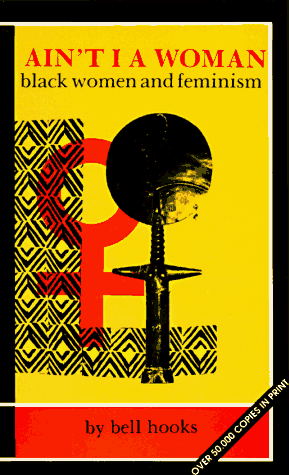
 In Bell Hooks’ seminal book, Ain’t I A Woman: black women and feminism, she is angry, disappointed, highly critical, and leaves no stone unturned. Everyone and everything falls under her critical magnifying glass of historical observation of white male patriarchal oppression, critically examining the failure of various historical freedom movements to include black women. Hooks argues that race and sex are inseparable when analyzing the historical impact of sexism on black women.
Hooks begins her treatment of the sexual/racial politics of feminism “in a retrospective examination of the black female slave experience.” But, for Hooks, the oppression of the black woman began long before landing on the shores of the American colonies:
“White male observers of African culture in the 18th and 19th centuries were astounded and impressed by the African male’s subjugation of the African female. They were not accustomed to a patriarchal social order that demanded not only that women accept an inferior status, but that they participate actively in the community labor force” (16).
While it is interesting that hooks generalizes the behavior of African men in such a broad Africa context, one which happens to include a multicultural network of several languages, religions, societies, clans, ethnic groups, subcultures, she also makes an interesting historical observation of black women in African context:
“The African woman schooled in the art of obedience to a higher authority by the tradition of her society was probably seen by the white male slaver as an ideal subject for slavery. As much of the work to be done in the American colonies was in the area of hoe-agriculture, it undoubtedly occurred to slavers that the African female, accustomed to performing arduous work in the fields while also performing a wide variety of tasks in the domestic household, would be very useful on the American plantation” (17).
Much of this book is rigorously analytical but also repetitious. She continuously assert the notion that white and black men hate black women, and that black men and white women have also historically denied and resisted the chance to align their struggles to a tantamount movement which would strengthen the force of the both movements and bring pressure to the white male patriarchal oppressive establishment. For Hooks, it is almost as if it has become the greatest American conspiracy, and the enemy isn’t simply white racist men:
“Black men have shown the same obsessive lust and contempt for female sexuality that is encouraged throughout our society. Because they, like white men, see black women as inherently more sexual and morally depraved than other groups of women, they have felt the greatest contempt toward her” (110).
But there is a light at the end of hooks’ otherwise bleak kaleidoscope of black female struggle against white (and black) male supremacist patriarchy. Ain’t I A Woman cannot be fully absorbed in one reading, and it cannot be fully appreciated for what it brings to the dialogue on black feminism unless the reader is willing to linger and ponder with the matters Hooks brings to light. The book is rigorous and dense, and Hooks sources are rich and vast. But, the book is also passionate and engaging, and Hooks forces us to confront our humanity, and to look at who and what we have become by deepening our understanding of the black feminist struggle in America.
5/5
What did you like about the book?
Hooks provides a very detailed chronology of feminism. The book broadened my perspective on black feminism, and does an excellent job of placing the feminist struggle in broad historical context.
What did you dislike about the book?
At times, I felt as though Hooks was sharing personal feelings rather than critical analyses, as though she has it in for all men. She completely overanalyzes Frederick Douglass’s essay “What the Black Man Wants”, asserting her belief that Douglass (a suffragist), was more interested in black men gaining the right to vote, and that black women should secede and adopt a gradualist approach to their suffrage cause. Yet, Douglass clearly stated, “I hold that women, as well as men, have the right to vote, and my heart and my voice go with the movement to extend suffrage to women…” At times, it seemed as if Hooks was making argument for argument sake, to flex her intellectual acumen, rather than put forth legitimate critical grievances.
What could the author do to improve the book?
This book is missing something, but I don’t know what that might be. I have lingering questions on Hooks’ treatment of black male patriarchy, and her essential claim that black men hate black women, and that black masculinity imitates white masculinity. But ultimately one needs to deal with the book and let the subject matter linger. I’m certain I’ll read it again.
 what about the kennedys