

Backing Hitler: Consent and Coercion in Nazi Germany
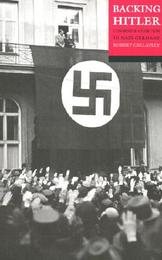 What is most impressive about Robert Gellately’s book is the somewhat unconventional methodological prowess the author utilizes to form the basis of his thesis which explores the degree to which the German people knew of the Jewish atrocities taking place right in their own backyards. With “extensive use of newspapers,” Gellately exposes the German people as active and duplicitous agents in the Nazi regime, having helped facilitate the regime’s evil deeds. Gellately’s provocative study may be the most thought provoking, extensive study as to how and why the German people eventually embraced Nazism (and Adolf Hitler) during the course of the Great Depression and World War II.
Backing Hitler: Consent and Coercion in Nazi Germany makes the claim that most Germans were aware of Nazi atrocities, and yet found them tolerable as a means to combat crime. As well, he notes how Germans embraced Nazism as a remedy to the financial and cultural corruption they’d seen in the 1920s and early 1930s during the Weimar Republic.
With the exception of the Holocaust, Nazi government officials and agencies such as the Gestapo and the SS did not hide the existence of concentration camps and torture from the general public, but instead, allowed them to be published both in Nazi journals and daily newspapers. The Holocaust itself was not hidden, except for its most virulent, deadly phases, in which Jews were dealt with via “special handling” (the Nazi euphemism for genocide). Only towards the end, during the final months and weeks of the war, did the German public see the most brutal aspects of the Nazi regime. Yet surprisingly, many Germans continued to support the regime until the very end. I doubt if Gellately’s premise is original, but Gellately offers fairly persuasive evidence to demonstrate how a social consensus was reached within German society in support of the Nazi regime. In that regard, Gellately’s book may be considered a seminal work because it is the first study that looks at how the German media played a (major and key) role in disseminating Germany’s philosophical tyranny.
Gellately does a remarkable and noteworthy job searching through historical archives – especially old newspapers – to give the reader an insight into what information was available to the German public. The fact that the Nazi publicized the formation of the concentration camps and the marginalization of the Jews and Gypsies speaks volumes about the anticipated public reaction. Gellately notes that most Germans interpreted this as part of the larger Nazi law and order campaign, and therefore accepted Hitler’s “eliminationist” tactics as a necessary strategy for moving Germany toward a more wholesome future. A future bereft of “drunks, criminals and layabouts.” In that regard, the German people were in support and compliance with the Reich’s commitment to “‘restoring’ the grandeur of the Reich and ‘cleaning out’ alleged ‘aliens’ in politics and society.’” What is terrifying about the book is not just the German public’s passiveness and duplicitous sentiments toward the Nazi propaganda, but the moral and spiritual dilemma the book subsequently poses: If the German public had not acquiesced to the nefarious Nazi propaganda, perhaps millions of people might have lived through the war.
The down side of the book is that at times it is repetitions and it could have used a good editing. The subject matter is dense, but that may not have been able ti be avoided. This is an important book, and even with the above limitations it is a worthwhile read.
Certainly, the strength of Gellately’s work is it’s methodological approach. It interrogates and examines the surviving newspapers, magazines, and dossiers from the police and Gestapo. The author meticulously explores the plausibility of the German society’s duplicity in Nazi terrorism, and how they participated in the Holocaust. We learn, for example, that the Gestapo appears to have largely relied on public censure rather its own research and intelligence. Especially intriguing are the author’s review of a number of Gestapo files on individuals who were accused of betraying the regime in one way or another. From the limited sample that he has analyzed Gellately demonstrated that the Gestapo and other police agencies had the active cooperation of the citizenry in searching out offenders. Their sources were overwhelmingly citizen complaints (both open and anonymous). But the specifics of a number of these cases are both fascinating and disturbing in the extreme. For instance, a number of citizens used the Gestapo and the mechanisms of terror to get even with innocent people who had never violated the law.
On the other hand, I would like to have seen more discussion of the sampling techniques used in the book. In many cases where the author examined police dossiers, he said that he looked at “every other” file. This raises many questions: what exactly does he mean by every other file? What order were the files in: chronological, alphabetical, random, some ordering scheme he used while going through them? This question is not answered. With a good ordering, it would be trivial for him to adjust the files to give the results he wanted to prove.
Overall, Backing Hitler is significant and relevant to German historiography. It courageously tackles a difficult question, yet, manages to come to a logical and well thought out conclusion. It provides an excellent discussion on the propaganda fed to the public and therefore deserves to be part of any collection on this era of history. Conclusively, this study is a good-read because it raises critical questions on the matter of Germans during the Third Reich, and their support of Hitler.
Works Cited: Robert Gellately, Backing Hitler: Consent and Coercion in Nazi Germany (Oxford University Press: New York, 2001): 6; David Allan Levine’s book, Hitler’s Willing Executioners: Ordinary Germans and the Holocaust (First Vintage Books Edition: New York, 1997)
 what about the kennedys
I agree with most of what is said here.
LikeLike
This is a most interesting review, Push, and one of your best. I’ve followed political news about Germany since Shirer’s book came out long before your time. The book on Hitler you review here is sure to garner pros and cons, many of them hateful, but we need to stay fully aware of the noted arrogance of the German mind and their firm belief that they are born rulers. Wagner and Nietzche were not the exception, but the norm.
When better reviews are written, leave it to Push to shine!
LikeLike