

Faces of History: Historical Inquiry from Herodotus to Herder
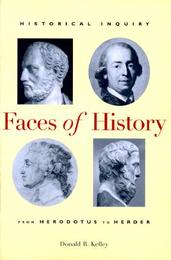 Donald Kelley’s Faces of History: Historical Inquiry from Herodotus to Herder is a meticulous account of the development of Western historiography from its Herodotus-Thucydides beginnings to the point at which it became an organized and institutionalized discipline. Impressively, Kelley’s study investigates twenty-five centuries of historical practice, focusing on persistent themes and methodology and how modern and contemporary historians have analyzed their predecessors throughout history.
Throughout the pedantic Faces of History…, Kelley carefully explores the historiographical trends of noted Roman historians like Sallust, Livy, and Tacitus, to explain how “roman historical writing developed out of a deep and to some extent parochial sense of tradition and location.” Successively, Kelley lingers with what he calls the “hermeneutical condition…establishing meaning from and for a contemporary standpoint.” Ultimately, Kelley’s fundamental challenge is offered in the question of how do we as modern historians deal with the problematic dilemma of locating the beginning of history itself.
The first chapter begins with an analysis of the distinction between what is myth and what is history. But before Kelley does this, he duly notes Herodotus and Thucydides as the founding fathers of Western historical inquiry. According to Kelley – and as the Janus-faced double herm of Herodotus and Thucydides might suggest – perhaps both historians had different methods of historical inquiry hence the contemporary methodological debates inherent in the discipline. For Kelley, Herodotus was a man of broad vision and gave birth to the discipline of historical inquiry. Thucydides main concern was lay with “explaining events in terms of causes, immediate and underlying, and the actions and motives of political and military participants like himself in the historical process.”
Kelley first gives philosophical meaning to the question of myth versus history via an “old and familiar story” that suggests history began as myth and eventually “gained full enlightenment” in the age of the great philosophers and thinkers. But, for Kelley, the existential dilemma (and a reoccurring one throughout the book) is one in which we must answer the perennial question, what is history? The assumption that Herodotus is the exemplar model of historical inquiry is a dubious one because his methods are not modern and proper, on the one hand; yet, for some scholars the pre-Herodotean and extra-Greek writing “all become potential forms of history [because] many of these indeed provided Herodotus with materials or models.”
The European perspective is too narrow because it sidesteps the possibility of other cultural and geographical ideas and interpretations of the question, while the medieval conception of history ranged from the sacred to the secular, kings and popes, saints and sinners, and displayed a sharp of class, yet, it denied the importance of gender.
If the writing of history in the Middle Ages could be construed as a “call to action” as Vincent of Beauvais would have it, then the Arsenal Old Testament validated the crusade regardless of outcome. In the medieval conception of history, especially biblical history, the past affirmed the legitimacy of the present. Historical writing and imagery was selective, guided by present necessities and conversely, contemporary events were presented as the fulfillment of prophecy. This “secularization of typology,” as Gabrielle Spiegel has labeled it, was a central element in medieval historiography. Sixteenth-century writers were creating a “rhetoric of nationhood” through many literary forms, including history. As for the changes in Western historiography, Kelley notes at length that,
By the end of the eighteenth century, the study of history had achieved the status not only of a literary genre, discipline, and “science,” with its own complex history, but also of a profession… What was new in the Enlightenment was the encounters between history and philosophy, which had likewise, and even earlier, emerged as a professional field with an academic base. The confrontations and rapprochements between these two old rivals, which occurred in a variety of cultural contexts and on several levels, were central to the “Enlightenment project” and to the rise of modern historicism and have been central to Western historical studies down to the present. They are central, too, to more recent debates over modernity and postmodernity and over the “end of history.”
The humanistic approach to history gave way to the pronouncement of the historical method. Kelley concludes his worthwhile book with erudite and philosophical belief that, over the span of twenty-five centuries historicism has been a pragmatic approach for historians. Kelley believes that that it is advantageous for contemporary scholars to be concerned with the nature of historical inquiry in the pre-modern sense. However, the Kelley lingers with the Greek foundations throughout the book, and his own reflections about those historiographical origins illuminate the final chapters of the text.
The strengths of Faces of History… are plentiful and the weaknesses are few. The strength of the book highlights the relationship between history and rhetoric, as well as the nature of historical evidence. Kelley also focuses upon a number of crucial stages in the history of historical inquiry, the most prominent of which are Christianity, the Reformation, and the discovery of the New World. For my own and personal concern, the book relies too heavily on European interpretation of history while neglecting the possibility of exploring other ideas and interpretations of history. In other words, Kelley unnecessarily “enter[s] a minefield of conflicting ideas, interpretations, and interests” due to his inability to conceive of the possibility that someone else – other than the Greeks and the Romans – may possibly have an intellectual opinion on the issue of historical inquiry.
Works Cited: Donald Kelley, Faces of History: Historical Inquiry from Herodotus to Herder (Yale University Press, 1998), 48; Daniel H. Weiss, Biblical History and Medieval Historiography: Rationalizing Strategies in Crusader Art; Robert André LaFleur, “Faces of History,” The Sixteenth Century Journal 31 (Fall 2000). 950-2.
 what about the kennedys