

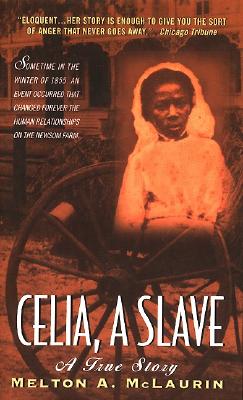
 Melton McLaurin’s Celia A Slave: A True Story is a secondary source which may leave readers to question the author’s recollection of the murder and trial of this mid-19th century Missouri slave.
McLaurin frames his story around the pervasive and engulfing dilemma of complex antebellum issues: not only of the slavery question, but also of legal issues such as the antebellum southerner’s view of their slaves as both chattel and persons – a paradox reflected in the legal systems; and of the role of women – black and white – in a white male society. Patricia Morton explains that “one of the essential legal differences between slave and free women was that free women were protected from sexual assault by law.”[i] McLaurin’s story is tightly focused and his style is simple and meticulous. However, it appears as though Melton is more determined to exercise his journalistic prowess and his keen sense of historical memorization rather than use his research skills to let us into the drama of Celia’s tumultuous life. McLaurin is rightly preoccupied with the historical specifics and legalities of the issues facing pre-Civil War America, but he is unable to lay bare the drama of Celia and her tragic life as a repeatedly raped slave.
Arna Bontemps believes that the true significance of slave life rests on the authentic autobiographies and testimonies of black slaves.[ii]My major disappointment with McLaurin’s book is its inability to account for Celia’s pain and testimony of what really happened. There is no testimony, memoir, record, or anything of the sort from Celia. All we get is her tragic dilemma from the perspectives of a bunch of slave-owning roustabouts whose only concern was the profit the slave’s labor would bring. Also, McLaurin’s bibliography tells me that he was not interested in extracting the truth of what happened on Saturday, June 23, 1855 since the bulk of the Celia’s rape comes from notoriously racist newspapers owned by whites. Even the black newspapers of this time often looked to the white newspapers for information and tended to mirror their interpretations. His primary documents consisted mostly of “agricultural schedules…biographical directories…statistics…population schedules…and [state] statutes….”[iii] The only reputable piece of documentation was the court file (4496) of the actual court proceedings, “State of Missouri versus Celia, a Slave.” McLaurin he knows his research is questionable:
What follows is not intended as a comprehensive bibliography of scholarship on slavery or of a specific aspect of that institution….Rather, what is provided here is a list of those documents newspapers, and census materials from which this work was drawn, in addition to those secondary sources, books, and articles that were most frequently consulted.[iv]
While McLaurin’s book lends itself by way of biased primary documents and secondary sources, Celia is left to suffer an existential and Ellisonian dilemma in which the context of her situation of rape is revisited, but she remains invisible. It is difficult for any historian to examining “the responses of African-American women to the social and economic conditions of slavery and the Civil War based on the lives of Celia” if we all we have is McLaurin’s take on the matter. All we can say is that Celia responded to her horrible socio-economic situation by killing her rapist. We cannot logically conclude that how Celia really reacted to her social and economic conditions since there really isn’t any neutral, reliable testimony, nor sufficient data, documentation, or resources from which to glean the information necessary to yield a plausible conclusion.
The problem with Celia’s story is that McLaurin’s assessment is based on unmerited court records, unaccountable correspondences, racist newspaper accounts, and the feeble and untrustworthy testimony of white folk. I didn’t get the satisfaction from McLaurin’s book that I did with Jannely Almonte’s wonderful research paper, “Women in Bondage: A Documentary Exploration of Vulnerability and Exploitation in Slavery.” For instance, in Almonte’s work I appreciated the way she used “the voices of slave women themselves to capture the horror and brutality of their existence.”[v] The paradox of McLaurin’s work is that it alienates Celia (the most potent character) from her own dilemma, while attempting to rescue her from the annals of obscurity and invisibility. As for Celia’s side of the matter…well…we may never know her story.
Endnotes
[i] In Patricia Morton’s “Discovering the Women in Slavery: Emancipating Perspectives on the American Past.” Pg. 132.
[ii] In Arna Bontemps, Great Slave Narratives, pg, 8.
[iii] From McLaurin’s index, Celia a Slave, A True Story
[iv]Quoted from McLaurin’s Celia a Slave, A True Story, pg. 166.
[v] Quoted in Jannely Almonte’s “Women in Bondage: A Documentary Exploration of Vulnerability and Exploitation in Slavery,” introduction.
Bibliography
Almonte, Jannely. A Research Paper. “Women in Bondage: A Documentary Exploration of Vulnerability and Exploitation in Slavery.” United States History — School, March 1999.
Bontemps, Arna, ed. Great Slave Narratives. Boston: Beacon Press, 1969.
Duster, Alfreda. Crusade for Justice: The Autobiography of Ida B. Wells. Chicago: The University of Chicago Press, 1970.
Franklin, John Hope. Reconstruction After The Civil War. Chicago: the University of Chicago Press,1961.
Garvey, Amy Jacques, ed. Marcus Garvey: Philosophy and Opinions. New York: Atheneum, 1969.
Gates, Henry. The Classic Slave Narratives. New York: Mentor Books, 1987.
Giddings, Paula. When and Where I Enter: The Impact of Black Women on Race and Sex in America. New York: Quill William Morrow, 1984.
Hine, Darlene Clark. Hine Sight: Black Women and the Re-Construction of American History. Bloomington & Indianapolis: Indiana University Press, 1994.
Kishlansky. Mark, ed. “How to Read a Document.” New York: Harper Collins College Publishers, 1995.
Massey, Mary Elizabeth. Bonnet Brigades. New York: Alfred Knopf, 1966
McLaurin, Melton. Celia A Slave: A True Story. New York: Avon Books, 1991.
Mitchell, Reid. Civil War Soldiers. New York: Penguin Books, 1997.
Morton, Patricia, ed. Discovering the Women in Slavery: Emancipating Perspectives on the American Past. Georgia: The University of Georgia Press, 1996.
Taylor, Susie King. Reminiscences of My Life: A Black Woman’s Civil War Memoir’s. New York: Arno Press and The New York Times, 1968.
Zinn, Howard. On History. New York: Seven Stories Press, 2001.
 what about the kennedys