

- (Dr. Melise D. Huggins)
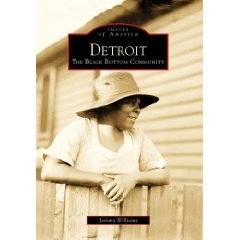
Jeremy Williams’ Detroit: The Black Bottom Community: Giving Voice to Stories, Histories, Ancestors and Living Life Makers
by Dr. Melise D. Huggins
It is important to note the poignancy of the term Black Bottom. It hosts an amalgamation of concepts, things and locations related to Black life in America. It is neighborhood enclaves, music, a dance; projects of struggle and displacement; a blog about African American politics, culture and activism; even cupcakes, cookies and biscuits. All terms, refer to some aspect of black life and living; the term even refers to a black derriere. I choose to identify for us that the black bottom relates to almost anything that describe black people, our richness, empowerment, collective history and memory. The black bottom is the source of all things good; from collective human lineage to soil.
Jeremy Williams’ book Black Bottom is about the same; a recollecting of the pieces of a life, the strings and threads that weave an identity: a story to tell. And this is the important work of storytellers, griots, local historians, chantuelles, citizens and dwellers: to resurrect our stories from obscurity; to right stereotypical images from lived realities and form them into multi-dimensional humanism. Historian, artist, writer, father, Detroit lived Jeremy, has Black Bottom as his origin, so this is a personal story. And what does this place in Detroit tell us about the corners of our lives and the places where we have lived, made a living and now, live, through time? We know our stories and lives have roots that are deeply connected to unknown places and spaces. Are we not called then to remember our pasts?
Detroit’s Black Bottom was a place home to American Indians, Rich Soil, European Immigrants, and African Americans. It tells of a dynamic history through time until World War I: from that history to current, do we know that despite the current downslide in Detroit Michigan such a culturally, ethnically rich community existed? The story tells us what and how much we did with little, and how women were called then to manage their homes and families; wife and mother was prostitute same. What has changed? How does that history contrast with current times where we have so much more, yet, our communities, like much of our history, are in dwindling and grave decline; doing less with more.
Williams’ Black Bottom begins a discussion of deconstruction. Should we allow it to, within us, it asks how did we march the dichotomy of our rich communities of the 30s and 40s to what we have now in the twenty-first century? And is that assessment to be contested?
Black Bottom is made for us as a community that survived for the people who lived there through their own limited resources in a period of Jim Crow, flourishing in spite of, and in the midst of racism and separation. Some thinkers raise the question of how integration disrupted the amassing of black wealth and was the destructive source of our inherent residential communities and Collectivity—where we owned our own businesses, lived together up, down and across social status; and enjoyed a bustling cultural heritage. Nothing then was needed outside ourselves and our communities.
From that period, we cross the bridge that was the wish of and for African American integration with white society and living; at what cost of what dereliction and community degeneration? Do we ask ourselves the reason and treason for the demise of such communities? Herein the reasons of telling our own stories; to know that what we see and experience today was not always what obtained, to lead us to the valley of self reflection and the possibility of and to change. Before that, to understand why and how things changed. And what is our current agency? Are we to reconstruct these communities? Can we return? There is much to ponder. And for that spur to excavation and thought, we thank Jeremy Williams for writing that journey road.
Dr. Melise D Huggins, Wednesday, November 04, 2009
 what about the kennedys
One Reply to “”