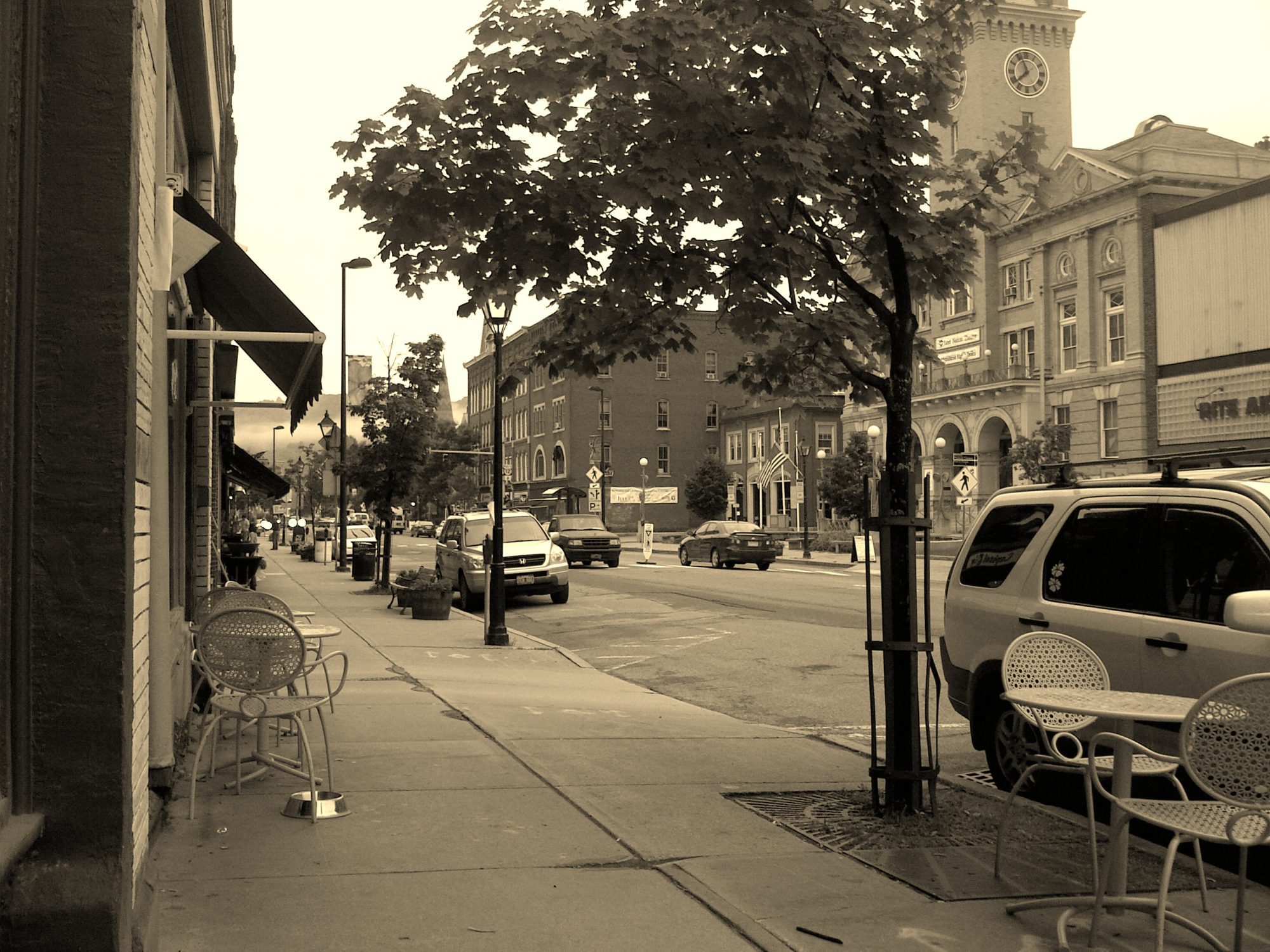

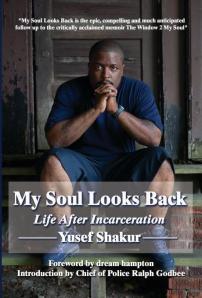
Winter’s fierce wind swirled white snowflakes on dark concrete canvas – random motions – while desperate vagabonds lingered wearily close to pedestrian prospects strolling along the blight and decay of a west-end corner (where federal troops once marched stridently to Roosevelt’s beat, and held black tourists in distant corridors while white miscreants assaulted, attacked, burned, rioted, killed, murdered, and broke the law with impunity; just a few blocks south, that historical intersection where the 1943 race riot took 34 lives); just a few doors down, I sat and waited and pondered on the aims and directions, as well as the moral and ethical dilemma facing anyone brave enough to take on the job of fixing all that ails a steadily crumbling industrial-plex, a burned-out has-been of former titanic glory – Eliot’s Wasteland – throat slashed, bound and gagged, paralytic, bleeding to death and left for dead; a.k.a. the present backdrop for Yusef Bunchy Shakur’s new book, My Soul Looks Back: Life After Incarceration.
I met Shakur at a local book event a few years ago. He spoke passionately about (passionate) activism, real black power, progressive Detroit politics, and he eventually asked me to review his first book, The Window 2 My Soul . Since, he has continued his struggle to improve the quality of life for Detroit citizens, a tireless effort which comes with no monetary compensation, no fancy office space with desk and privileges and pension and profit-sharing and élite niceties (carte blanche to validated parking and free pussy), no Starbucks advantages, no free lunch ticket, just a deep-seat (almost enigmatic) love for the City of Detroit. And a sustained hatred for evil and injustice.
I do not care to compare, juxtapose, reference, or acknowledge in any sustained way, Yusef’s first book to any parts of My Soul Looks Back because I believe that books – especially memoirs (which is what this appears to be) – should show the author’s ability to transform and transcend. That stated, a memoir should consist of (almost random-like) snapshots of the most important and poignant sorts, revealing the important developments of a person’s personality. Memoirs are more flexible than autobiographies because, unlike autobiographies, it is not necessary for the memoirist’s story to begin at birth. So, in order for me to consider the veracity of Shakur’s book, it was necessary to begin my critique at this particular point.
Essentially, My Soul picks up where Window left off (Shakur is essentially still concerned with the matter of his soul inasmuch as how he can expiate and atone for his past indiscretions) and opens at the point in which Shakur is granted parole. Shakur “overstood” his mission before he even boarded the bus: “I fully embraced my new desire to be a souljah for my people…” From that point on, Shakur sets about the task of transforming himself from a vicious and hardcore ruthless criminal to a credible revolutionary. To do this he examines that which has prescribed his sojourn, confronting his destiny head on to turn “undeveloped human beings” into productive and conscious citizens who will no longer lie down slow to die quietly. Shakur’s socio commentary is sharp; his cultural criticism is dynamic; and his political observations are pensive and fully charged. At this level, the book read as critical socio-cultural commentary at its best:
While I waited on my sister Rachelle to come and take me to visit my son, I had my sister Julia drive me down to my neighborhood Zone 8. As we drove through Zone 8; the place I loved so much and was ready to die to defend its honor, I noticed it had been reduced to a ghost town. Actually it had always been a ghost town, but this time I was looking at my neighborhood through the eyes of life instead of through the eyes of death. Zone 8 like so many other Detroit neighborhoods suffered from years of social, political, educational, cultural and economical neglect that was manufacturing neglectful human beings. Many of the elected officials, business folks and clergymen saw the need to beautify downtown Detroit while turning a blind eye to the neighborhoods. The foundation of any city is it neighborhoods. When you fail to invest in the neighborhoods, you are doing your city and your greatest resource, which is the people, a huge disservice. They fail to overstand that we can’t have a strong city without having strong neighborhoods. I look at the blight, abandoned buildings and empty lots in Detroit neighborhoods as a direct result of misappropriated funds, political/religious/community activist/non-profit corruption and a lack of vision by those who so desperately want to lead this city and its residents. The more than three decades of abandonment buildings still standing in Detroit neighborhoods is an ironic metaphor for the heart of this great city, which continues to fight for survival after having been left to create beauty out of some ugly shit.
Yet, at other time the book works as a memoir, a hybrid, cross-genre of memoir, biography and social commentary. Most compelling is the intelligent way in which Shakur’s observations contrast the then-and-now-ness of Detroit, its political landscape, post-industrial collapse, and social predicaments. But hope is not lost, and people do care. Ted, a former mentor and neighbor from Shakur’s old stomping grounds, “was a man trying to implement positive and productive change in our neighborhood by contributing to helping our neighborhood maintain the look of being a neighborhood and not a ‘hood” (16). In the end, the struggle for rebirth takes full throttle, Shakur finds redemption, and My Soul may meet its goal:
I rationalized that as long as I rejected God’s plans for me nothing ever worked for me, but once I accepted his plan for my life everything begin to work for me. He transformed me from an uneducated thug to a college graduate, author and speaker. He took me from a community destroyer to a dedicated father committed to restoring the neighbor back to the ‘hood. Through the grace of God I became a champion of the people, and a testament of what it meant to submit to do his will. I am neither a Christian nor a Muslim but I do believe in God. I am not a religious man but I am spiritual man. I don’t prescribe to any organize religion but I do practice spirituality in everything I do. I don’t believe I have to attend a church or a temple to have a relationship with God but I do believe my commitment to improving the quality of life affords me a strong relationship with God everywhere I find myself (186-187).
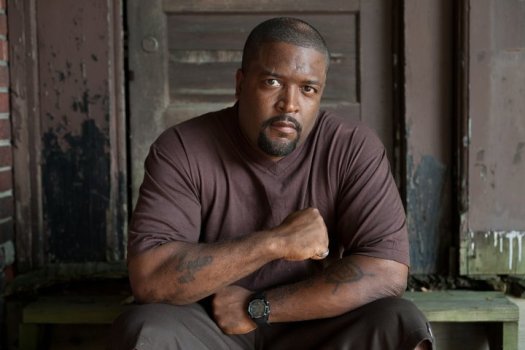
Yusef finally arrived and we took a booth at the front end of the Coney Island, shook hands, sat, sipped water and ordered breakfast. Shakur looked tired and dubious and all alone; his luminous eyes struggle to hold on to some fading glimmer of hope. He seemed disconsolate (crestfallen….like when Jesus wept) during certain moments of our discussion, and I asked how his recent lecture-tours had come along. He looked like Martin had the day before his assassination at the Loraine, when he stood at the pulpit, his last “Mountaintop” speech, and spoke those cryptic words: “Like anybody, I would like to live a long life. Longevity has its place. But I’m not concerned about that now,” the Rev. Mr. King said that evening. “I’ve seen the promised land. I may not get there with you. But I want you to know tonight, that we, as a people, will get to the promised land!” Yusef reminds me of King’s last dawn, the day before the end, even as Shakur ate, drank, reminisced, and waxed eloquently the matters of his heart, those things he is dealing with in his personal and political life (both are inextricably linked), and the dark and mysterious road set ahead.
The following day I finished Shakur’s book. I absorbed the pain and the hopes and tragedy and hope and expectations and recognized the appearance of a pending doom. At times, the memoir seemed preoccupied with the inhumanity of the prison industrial complex, and how prison does little to rehabilitate or prepare ex-felons for life after incarceration. The following lengthy passage defines the political and economic agenda (according to Shakur) of the American penal system; how the “the prison administration and the parole board wreaks havoc on its prisoners”:
Many of them have been left for dead within the belly of the beast to be mentally, spiritually and physically tortured by their captors. There are numerous prisoners who have not received a letter or visit in years from their family members in decades. Unfortunately our community and family members have bought into the negative hype that is perpetuated by the mass media about prisoners and prisons and leave them behind enemy lines fighting for their lives against a beastly beast that wants nothing but their blood. I don’t say this to negate the undeveloped human beings we were that led to our criminal behavior and our imprisonment in the first place. However, we have to accept the harsh reality that prison was not designed with the intent to correct and rehabilitate human behavior and that it in fact does the opposite. Prisons are nothing but a temporary and inadequate fix that makes millions of dollars off of Black and Brown communities. In the last 20 years thousands of schools have been closed in Black and Brown communities across this nation, especially in the City of Detroit contributing to the 2.5 million people incarcerated in amerikkka. It costs close to $40,000 per year to house/storage a prisoner and between $7,000 and $8,000 per year to educate a student. From those numbers it is quite obvious that amerikkka the great would rather incarcerate than educate (11-12).
Collectively – inasmuch as how I view the book and what it explains about Yusef’s external and internal conundrums – it seems as though Shakur’s struggle is bigger than, even, perhaps, he has realized (which really seems a struggle and wrestle with the devil; a fight to the death with the irrational concept of time; a moral grappling of sorts for his own soul and humanity and freedom from something he has yet to reconcile within himself. That something which possibly resides within the very neighborhood he has returned to save….perhaps it is more about saving himself and not his neighborhood ….perhaps… Perhaps a revolutionary’s external struggle is an infinitesimal one that has more to do with how one reacts and responds to an emergency, rather than the real nature of the call itself….like a firefighter racing to a blazing building where people are perilously trapped inside….and, en route to save lives, he knows he has no water to distinguish the fire. But his temerity propels him forward.
 what about the kennedys