

People pay for what they do, and still more for what they have allowed themselves to become. And they pay for it very simply; by the lives they lead.
-James Baldwin
Why can’t women get along? Why can’t women work together? What are the main issues women have with other women? Most people ask these questions everyday….But what happens….When the very person that caused you hurt and pain is in need of your strength? What would you do? Will you draw close…or Turn away?
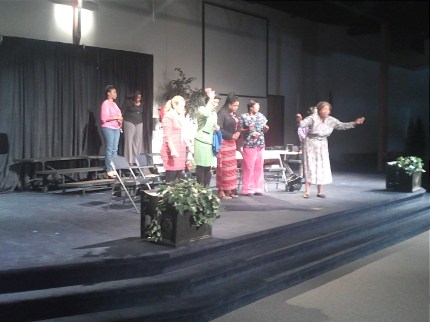
These are the crucial questions for Shawntay Dalon, writer and director of new stage play, My Sister’s Keeper, which premiered September 8th, 2012 at Faith Christian Assembly Church in Melvindale. Dalon’s play explores the timeless issues of love, betrayal, trust, and the matter of Christian faith and commitment. Though these issues may seem typical of African-American theatre (since August Wilson’s last play, Radio Golf), Dalon takes the game to a newer, fresher, technological level.
My Sisters Keeper opens on a Hitchcockian zoom-lens right into the privileged church, up perfect aisles, “Up domes—up spires—up Kingly halls—Up fanes—up Babylon-like walls” —beyond the holy pews, past the righteous congregation, the golden podium, the posturing preacher, his prestigious wife, and on beyond blessed doors leading to the sanctuary place to pin-point the inter-conflict of the Women’s Auxiliary Group beset in hot crises and scandalous turmoil.
This sanctified bunch (with its irascible leader) grapples and wrestles with the internal sins and external forces which set the course on collision’s trail straight towards the great Shakespearean question of whether to submit to the Christian way of forgiveness, which in turn motivates obedience to God, or to hold steadfast in anger and bitterness, and the blind penultimate decision which lay just before the last requiem. Gina’s marriage has flopped and she blames God for allowing the harlot, Rosalyn, to infiltrate her marriage and sleep with her husband. To make matters worse the churches auxiliary group has allowed Rosalyn to return to the church. Gina’s anger fuels and jerks and gesticulate with grueling despair and feelings of betrayal. This is the essential bones of the entire play, whose characters set about the task of analyzing and moralizing and philosophizing the tenets of what is right and what is wrong – to answer what seems to be the real underlying question: What Would Jesus Do?
Even though we’ve seen this type of play before, Dalon’s play still wins and works for several reasons: The acting (and Gladys Powe’s singing) is superb; the writing is superb; the directing is superb. Period. But Dalon’s real genius creativity lay in her use of technology. She used screens as narratives to project a kind of visualized periphery to enhance the overall effect of the plot’s development. For example, when one of the characters follow after another character who has left the church meeting to head to her car parked in front of the building, two giant screens allow us to view the two women outside of the building while simultaneously viewing the commotion on the inside (i.e. the stage) – an absolutely delicious visual effect. Also, Dalon’s uses the same technique to weave past with present narratives which serve to move the story along via multiple perspective forces. In this sense, she does a marvelous job fusing film and stage elements together to create somewhat of a hybrid form of theatre…..or something like that. I’m not certain if this technique is new or not but I was totally enthralled and impressed to witness something I felt was innovative. Dalon took it to a new level. Kudos to MSK and Mad respect to Dalon!
 what about the kennedys