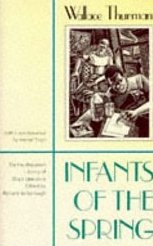
Book Review: Infants Of The Spring, by Wallace Thurman
I’d spent the best of the brisk evening at Camelot discussing art, literature, Detroit, and the direction of my novel with my good friend and confidante, (Ypsilanti poet) Nina Simmone. It was getting late and Nina opened another bottle of wine while I looked through her small collection of books, searching for something to soothe my dreary discontentment and pervading disillusionment that the Detroit lit scene would revive something resembling a serious literary movement. In these dark cupboards, I hoped there would be something worthwhile that would magically spring me back to where I had began nearly a year early, the hope and certainty that my literary life would not disintegrate to meaninglessness, that my love for words, thoughts, and reflection had not been a Sinatra-esque nightmare (“for all… for nothing at all”). “Something,” I murmured in between large gulps of cheap Villa Giada Moscato D’asti, “something in this cabinet must restore my faith.” (“Drunk talk”, Nina calls it.) I selected Wallace Thurman’s novel, Infants Of the Spring, and climbed into Nina’s king size sleigh bed with burning cigarette, refreshed wine, and Nina’s solemn promise that she would not disturb me.
Thurman’s mercurial novel begins at 267 West 136Th Street, Niggerati Manor, where he resides with other artists, writers and singers. It is the hottest spot in Harlem and everyone hangs out at the Manor, oftentimes contributing to the poor and struggling residents via rent parties and food fairs. Langston Hughes, Zora Neale Hurston, Gwendolyn Bennett, Aaron Douglas, Richard Bruce, John Davis and, of course, Thurman mostly comprised the Niggerati – a name given by the colorful and witty Zora Neale Hurston (in defiant snub of the moral and philosophical beliefs of the black elite). IOTS is anchored in the dubious confines of the Harlem Renaissance, along the scandalous route of a penitent Thurman whose sole preoccupation is to deconstruct the movement’s legacy, demystify its white gaze, and disassociate the Manor members from the larger foray of the Renaissance Movements chief critics.
The novel is satirical and it challenges the pervasive issue of intra-racism and prejudice which permeated black circles of Thurman’s time. He rejects the notion that the Harlem Renaissance was a legit movement, the older literary front (which included Du Bois) conflicted with the younger cats who were unfocused, unproductive, and disenchanted…and gay…lesbian…and radical. In the end, Thurman is thoroughly disenchanted with the possibilities of the HR movement:
I don’t expect to be a great writer. I don’t think the Negro race can produce one now, any more than can America. I know of only one Negro who has the elements of greatness…the rest of us are merely journeymen, planting seed for someone else to harvest. We get sidetracked sooner or later….we become mired in decadence. None of us seem able to rise above our environment.
Wallace Thurman
For Thurman – whom Langston Hughes called “a strangely brilliant black boy” – white patronage ultimately undermined the potential for black artists to gain equal par to their white counterparts, other than the temporary relief of exploiting white patronage. Much of Thurman’s harsh criticism of black art perhaps stems from his own inability to find a place within the broader context of American literature. Thurman certainly considered race as a major barrier to a black writer ever being taken as a serious American writer. In this most elegiac passage, Thurman wrestles with the matter at length:
No matter how bizarre a personality he may develop, he will still be a Negro, subject to snubs from certain ignorant people. The fact distresses him, although he should ignore both of it and the people who might be guilty of such snubs. He sits around helpless, possessed of great talent, doing nothing, wishing he were white, courting the bizarre, anxious to be exploited in the public prints as a notorious character. Being a Negro, he feels that his chances for excessive notoriety a la Wilde are slim. Since he can’t be white, he will be a most unusual Negro.
Infants of the Spring is a classic lesson which we can still appreciate today. This timeless novel is about struggling to be true to who and what you are. The role of the writer is often confusing and misunderstood, yet, IOTS brings us into a deeper understand of where we are as black writers today. For me, IOTS brought back a sense of purpose and meaning. I think it could do the same for any writer who finds themselves at the dubious crossroads with no way to turn.

 I’d spent the best of the brisk evening at Camelot discussing art, literature, Detroit, and the direction of my novel with my good friend and confidante, (Ypsilanti poet) Nina Simmone. It was getting late and Nina opened another bottle of wine while I looked through her small collection of books, searching for something to soothe my dreary discontentment and pervading disillusionment that the Detroit lit scene would revive something resembling a serious literary movement. In these dark cupboards, I hoped there would be something worthwhile that would magically spring me back to where I had began nearly a year early, the hope and certainty that my literary life would not disintegrate to meaninglessness, that my love for words, thoughts, and reflection had not been a Sinatra-esque nightmare (“for all… for nothing at all”). “Something,” I murmured in between large gulps of cheap Villa Giada Moscato D’asti, “something in this cabinet must restore my faith.” (“Drunk talk”, Nina calls it.) I selected Wallace Thurman’s novel, Infants Of the Spring, and climbed into Nina’s king size sleigh bed with burning cigarette, refreshed wine, and Nina’s solemn promise that she would not disturb me.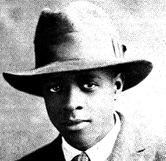
 what about the kennedys