

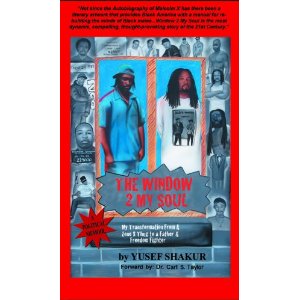
 Kafka said that what we need are books that hit us like a most painful misfortune, like the death of someone we loved more than we love ourselves, that make us feel as though we had been banished to the woods, far from any human presence, like a suicide. A book must be the ax for the frozen sea within us. Few Urban Lit novels ever really set out to achieve anything beyond the usual exploitative fulfillments of quick sex, fast living, fast cars, and bling-dreams. Rarely do these types of books provide any real food for thought, or give us any kind of life lessons, present real moral dilemmas, or present us with anything that help us to critically reflect on the world around us. So, in a sense, they become worthless reading pursuits because they do little to stimulate us at the intellectual level. Yusef Shakur’s new memoir, The Window 2 My Soul: My Transformation From A Zone 8 Thug To A Father & Freedom Fighter, is an exception to the rule.
Shakur, a former member of the notorious Zone 8 gang made a career of whippin’ ass and dodging bullets, but eventually caught a case and got sent to prison for nine years. While inside, he made amends with an absentee father, changed his game, and returned to his old stomping grounds with a new agenda. Along with his entrepreneurial spirit, activist goals, and a new bookstore, Shakur also returns with a book which he hopes will engage the people, uplift the community, teach the children, and inspire change. So, like James Forman’s Manifesto, or Malcolm X’s autobiography, or Harold Cruse’s Crisis of the Negro Intellectual, Window 2 My Soul is yet another one those coming-of-age stories, but this protagonist is not Huck Finn, but rather the bastard child of a fallen generation which has now bequeathed that evil element of self-hate to its progeny. A rather grim legacy, but a grimmer reality. This is a Bigger Thomas story all over again, postmodern blackness in neon lights, and Shakur pushes it to the limit with vivid narratives and a twisted tale that rivals Cleaver’s Soul on Ice. But this book is soul du jour because it illuminates the struggle, highlights the context, lays bear the pain, and expiate.
Window 2 My Soul is an important book because it shows Shakur’s transformation, and the possibility of redemption. In that sense the book appeals to us at the deeply human level and we are able to find ourselves in this prodigious story, and kneel at the pulpit with him. So Shakur’s book is a religious testimony to human endurance and the power of faith. And it is evidentiary to what can happen when we decide to take control of our lives and be responsible for our actions. Yet, unfortunately, this great book will perhaps fall on deaf ears, go unnoticed, and soon enough fall off the literary radar within a community that needs its message most. Instead of books like Shakur’s getting notoriety and recognition, those inane, unintelligible, shiftless books which provides only momentary pornographic release will continue to bombard our psyche (with unchecked regularity).
I highly recommend Shakur’s book. And so does (legendary Detroit activist) Grace Lee Boggs: “I recommend it to anyone seeking to overstand our s**t-uation. Whether you grew up in a ‘hood, a suburb, a gated community or an Ivy League campus, it will help you discover how you can begin to free yourself and our country from the dog-eat-dog, hyper-individualistic, hyper-materialistic, Darwinian, survivalist, violent capitalist culture, which is destroying our humanity and all life on our planet.” And, in addition to an impressive foreward by Michigan State University professor, Dr. Carl S. Taylor, you can’t get a better endorsement than that. This is the changing of the guard.

5/5
 what about the kennedys
Congratulations Yusef! Stellar review, Push!
LikeLike
Why is the book referred to as, and compared to, “novels?” This is a great nonfiction memoir that, if worthy of comparisons, would line up along such classics as Richard Wright’s “Black Boy,” Claude Brown’s “Manchild in the Promised Land,” “The Autobiography of Malcolm X,” and Shanyika Shakur’s “Monster: An Autobiography of an L.A. Gang Member.” Indeed, it is a coming of age story for this generation, one that takes a personal experience to shine an interpretive bright light on the conditions of black life in America.
LikeLike