
 Rage cannot be hidden, it can only be dissembled. This dissembling deludes the thoughtless, and strengthens rage and adds, to rage, contempt. –James Baldwin
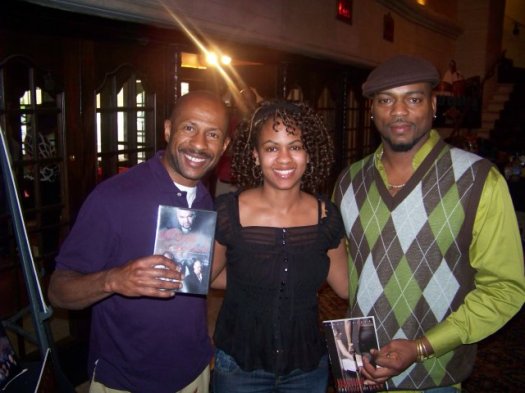
Oh! She looks so…delightfully bored, Janaya Black, I thought to myself as I stood in front of the odd collection of writers and folk-alike, a linear view beyond Versandra Kennebrew, through Dominee and Lenderrick and Sylvia and Yusef Shakur, three rows away from my center-front presentation at a recent Live Ladies of Literature Book Event at Biggby Coffee (on Woodward Avenue near Wayne State University). It was here that the smartly dressed filmmaker stood next to me near the latte counter, over by (Trinity Film Coalition partner) Marshalle Montgomery and made pleasant small talk before handing me a review copy of her latest novel, Beautiful Rage: The Break of Dawn.
Delta flight 2942 left Detroit Metropolitan Airport on time, and I settled into seat 6E and quickly ordered two of those small bottles of Cabernet Sauvignon. I thumbed through my BlackBerry, read text messages, viewed new pics, checked weather reports, deleted junk, and thought of an upcoming colloquia in Prescott (but especially Whiskey Row). I watched in “amused contempt and pity” the first-class snobs arranging expensive seat cushions, designer bags and Kindle reading devices, and I wondered if their first-class tickets included parachutes. I reclined my coach-status seat, adjusted my feet, thought of LF, stretched, drained my wine and opened my book to Prologue.
By the time we reached New Mexico I began reflecting on Black’s novel which, by now, had become a complex moral dilemma for me as well as a structural issue. Black’s interior monologue made it difficult to follow the flow because Dawn did most of the talking, and Vanessa’s character seemed flaccid and aloof, but as I continued reading I later understood Vanessa’s motives (more on this later). At times, the book read more like journalism and not a novel (Black is a journalist in real life), but it is a novel because of its Aristotelian structure (The beginning… The middle… The end with climax, resolution, premise….blah blah blah…) So, the plane continued on, I ordered more wine, ignored the broad seated next to me, and finished Black’s book by the time we landed at Sky Harbor Airport.
Beautiful Rage is a story about pride, redemption and forgiveness, and is told from the perspective of Dawn Langston, a prison inmate who decides to take part in the journalistic exploits of Vanessa Jackson, aka, “the Voice”. Jackson visits with Langston (an interesting choice for a surname) at the Wayne County Women’s Correctional Facility on several occasions to record her story of how she carefully and methodically executed a well-thought out plan to avenge the death of her sister. Truman Capote once said that “great fury, like great whiskey, requires long fermentation.” And Black plays on that notion, not only with the way she masterminds the abduction and murder of gangster Ross Styler, but the sinister act of deception and deceit with ninja–like precision. Dawn’s furious obsession – “blood lust” as she calls it – to avenge her sister, and her inability to forgive Styler becomes the point of focus and deep examination of hatred for Black, who, in turn, exploits Carmen’s death, giving an extended analysis of our own visceral humanity in the face of cunning vengeance – a spiritual examination of our inner incandescence, a moral indictment of our naked capacity to “take [a] life in cold blood.” For Black, it is the question of hatred and forgiveness and pride that sits at the center of the entire drama. The following lengthy passage bears this out:
” …now that you have been in here for this long, do you feel any remorse for what you did yet?” …”No, can’t say that I do. But I feel that God is working with me on that. Since I’ve been in here, I’ve found comfort in studying the bible. I understand the principles that it teaches and I’m learning to embrace them. I believe that in time I’ll feel worthy enough to go to God in prayer and ask His forgiveness for what I did. But until I can have remorse in my heart, I don’t feel like I have the right to ask God’s forgiveness for something I’m not truly sorry for. Call it pride or whatever, but that’s just how I feel about it. I just pray that I will be able to overcome that before it’s too late. Do you think that’s wrong?” …I contemplated her question for a moment and then responded, “I think that if you ask for forgiveness and mean it, then God will work out the rest. And you’re right, it is pride. Once you let your pride go, I think that you’ll notice a change in your life, Ms. Langston, and for the better. Your sister is gone and now so is her killer, and now you have to move on with your life. Hatred has brought you here, but who knows what might happen if you let it go.”
The “Push Rule” says that no book is perfect, and Black’s is no exception. Most people judge a book by its cover, so Black’s packaging is dangerous on two levels. Although I get the point of the book cover (“I purchased a skin-tight black leather mini skirt that barely covered my ass with a flaming red Dolce & Gabbana satin top to match“), the title seemed uncreative and misleading. This is unfortunate because Black’s book is really good. I think the title and cover could pigeon-hole the otherwise wonderfully crafted novel to the dubious confines of Urban Lit genre, which could cause it to miss critical attention on a broader literary radar. In other words, Black’s book is a refreshing read for me because it isn’t Urban Lit, it is well-written, speaks no ebonics, doesn’t glorify bling-bling dreams or haute couture ambitions, never uses the N word or gratuitous slang, isn’t sex-driven, yet, puts forth an honest attempt to wrestle with relevant social, moral and philosophical issues. (This alone sets Beautiful Rage on the outskirts of what most of her Detroit contemporaries are doing.) Unlike some of the vacuous urban books I’ve reviewed, Black’s novel is clean and edited (I noticed only two grammar errors…including a misspelling of “Gabbana” on page 56). Most impressive is Black’s desperate reflections on faith, God, and humanity (which she is certainly unsure of to say the least), and her sustained ability to grapple with the depths of our dark inner rage. This kind of intellectual deep-sea diving reminded me of Knut Hamsun’s Hunger and Ousmane Sembene’s God’s Bits of Wood:
Even in my blind rage and intent to seek revenge, part of me cried out to turn away from my wrath, which would surely lead me down the path of self-destruction. The turmoil I faced was enough to drive me to my knees for the first time in three years, to seek guidance from God. I knew that what I was going to do was wrong, and I also knew that all I had to do was turn away from my present course of action and walk away. …kneeling next to my bed, I prayed to God with hot salty tears streaming down my cheeks. I didn’t pray that He would give me the strength to turn the other cheek, but rather I prayed that once it was over he would find it in his heart to forgive me. I was going to do it my way first and ask for forgiveness later. I had tried to do things the right way the first time around and it didn’t work out, so I hoped that He would understand.
Then there is the matter of originality….”hey..haven’t I seen this somewhere before?” At times, Beautiful Rage reminded me of something from the Saw horror flick franchise…and that movie with Jamie Foxx and Gerard Butler, Law Abiding Citizen, where Gerard’s character, Clyde Shelton, avenges the gruesome murder of his wife and daughter. Ten years later, Shelton suckers the murderer into a booby-trap okee doke, paralyzes the absconder with a shot of tetrodotoxin, kidnaps him to a faraway obscure site, a self-designed torture chamber for a Dahmer-esque session of body dismemberment reminiscent of Jack the Ripper or Vlad the Impaler. Just like Dawn does with Ross Styler. And like Shelton, Dawn’s “lust for vengeance was the only nourishment I needed to get me through the day.” But Saw nor LAC deals with the conflict of deeds and doings and emotions like Black does.
Dawn loses her religion (“I had determined…that nothing, not even my inbred sense of right and wrong, was going to stop me from avenging Carmen’s death. I had come way too far to turn back now”) and ultimately becomes the very thing she despises: a cold-blooded, ruthless, merciless killer. And it is through Dawn’s experience – particularly her metamorphosis – that Vanessa voyeuristically examines her own humanity and her capacity to kill. Dawn’s story liberates Vanessa, so Langston’s dilemma and Carmen’s death is necessarily two-fold because 1) the story is sensational and juicy and saleable (the stuff of Pulitzers), and stories such as Dawn’s makes Vanessa a star journalist and the envy of her colleagues (“…you’re my star…this has to be your best work…look at all these awards…the various journalism plaques and certificates that decorated my wall….”). So Vanessa’s interest in prison stories isn’t as humanitarian as she would like to believe; she wants a Pulitzer. That is why Black’s characterization of Vanessa as journalist is integral because it connects us to Black’s humanity as well; 2) it is normal people like Dawn, the ones with the predictable lives – provincial, christian, good, decent, working class – whose life is thrown into a chaotic whirlwind of mess and mayhem, and is forever changed. These are the people whose misfortunes give us the greatest lessons in life. So Dawns’s life becomes sacrificed for the moral lesson of Vanessa…and Black…and us too.
Push Scale: 4/5
(click on pic for Janaya Black website)
 what about the kennedys
You’ve done it again Push. Thanks again for contributing to my new anthology “Welcome Home to Your Heart.”
LikeLike