

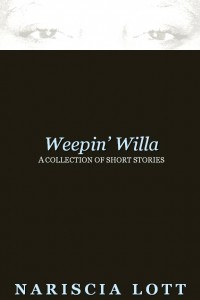
Short story writing is a serious craft to learn because it requires a certain mastery of time, space, and reflection. Not many do it well and those who dare to go out on this crooked and unstable limb often return broken, bewildered and bruised. Katherine Mansfield, Zora Neale Hurston, and Charles Bukowski are three of several writers who’ve mastered the short story form. (I like Svetlana Lavochkina’s fresh short story, Like A Real Man.) Nariscia Lott’s new book, Weepin’ Willa is an interesting collection of short stories and insightful moments.
My first impression of Lott’s book was one of great disappointment and disenchantment. It began when I retrieved the book form my PO Box, opened the package, and immediately noticed the poor quality of the book’s fragile binding. The book had a rather classic appeal to it but when I opened it to page one for my customary pre-reading of the opening chapter (to determine whether or not I would even continue reviewing the book) I noticed the binding was damaged. Bad glue, I guessed.
I decided to read the book regardless of Lott’s unimpressive presentation, and I am glad I did. Weepin’ Willa is a delightful collection of short stories which deal with a variety of interpersonal issues on provincial life, imminent death, physical deformity (idiopathic scoliosis), and cultural family values – over an extended period of time. Lott’s arrangement of these stories, and its aesthetic quality, may yet be understood but the dubious structure of the book also becomes part of our experience as we try to understand the leap and bound between “January 1996” to the very next chapter, “April 1955” for example, and the way(s) in which Lott crafts her sprightly characters. At times, Lott’s writing (tourist-like snapshots of random life) is idyllic and languorous, other times it is ebullient and vibrant with blissful humor and lyrical luster:
The sky was three or four shades of gray. Indianola had been transformed into a scene from an old movie – back before some genius came up with Technicolor. The tree branches sagged pitifully under the weight of the icicles and eventually broke away, falling like mini-missiles onto the infinite block of snow. The old neighborhood was exactly the same, except for the dead-looking trees and the ice (12-13).
Weepin’ Willa also has a certain poetic musicality that I haven’t experienced since my readings of Detroit poet Lyrical Love’s brilliant works of art, “Undressed” and “Circles”. At times, Lott’s writing is as musical as Capote. But the book is not perfect. At other times the writing lacked imagination and Lott’s treatment of black southern plantation life lacked historical insight. “April 1955” did not effectively deal with the 3-Ds of writing literature: Detail, Dialogue, and Description. Lott’s ill knowledge of the sharecropping system, black migration, and what Langston Hughes called “the ways of white folk” prevented her from writing a more rich account of black life in 1955 South, and the experience of moving north.
Yet, Lott does a good job exploring issues of sadness, death, and depression. I am always interested in what a writer does with sadness and depression beyond the revelation of it. Weepin’ Willa is good! At times I thought the writing was superb, the language was precise, and the stories were solid. At other times, as I noticed the temporality of Lott’s writing, I felt as though she may’ve published this book too soon, that, perhaps more editing was needed, more proofreading, more experiment with craft. Perhaps these prescient slices of Lottian moments should’ve been tested as blog entries….perhaps. Maybe a tight-knit writer-group could’ve helped flesh out some of the flaws and weaknesses within the book (which begin with its poor production). I don’t know. But I do know that Lott is a good writer, and Weepin’ Willa is a marvelous start for what I believe to be a promising beginning
Push Scale – 4/5
 what about the kennedys
WOW!!! 🙂
LikeLike