

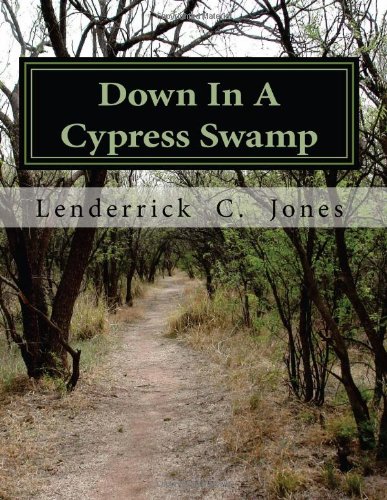
The first thing that struck me oddly of Lenderrick C. Jones was his audacity to publish a lengthy first novel. That takes balls and guts to gamble on such a prospect – a relatively unknown writer – to assume that anyone would want to sit through such a risky attempt by someone with no established reputation of any literary kind. So, then, the issue with Down In A Cypress Swamp (a title lifted from James Weldon Johnson’s poem, “The Creation,” in his 1927 publication of God’s Trombones) is one of audacity. What gives Lenderrick C. Jones the right to publish a début novel of 430 pages? Let’s load this down.
Alexander Lacroix is stranded in a typical position somewhere in Detroit, Michigan with his tenacious mother, Sharon, recalcitrant friends, blunts, and all ills besetting any teenager caught up in a tenuous situation of inner-city life. The story opens, interestingly (though this interest is ultimately left unimagined and unexplored, particularly given the place Alexander and cousin Quinton smoke “optimo rolled” blunts before Alex begins to “zone out and focus on silly shit”) on “the roof outside of his bedroom window.” Perhaps it is the marijuana which suspends his ability to see more clearly his situation – that which lurks beyond the rooftop-view – and why he wants to move back to Savannah – or why the conversation, for Jones, must take place here, on a rooftop over-looking somewhere (which is never quite fleshed out for us, but is important to know – like what Ann Petry does with The Street, exploring a plethora of plangent themes and timeless social concerns).
At times DIACS reminded me of Nariscia Lott’s collection of short stories, Weepin’ Willa, a particularly (and I still do not know why I like this) marvelous passage from “January 1996”:
The sky was three or four shades of gray. Indianola had been transformed into a scene from an old movie – back before some genius came up with Technicolor. The tree branches sagged pitifully under the weight of the icicles and eventually broke away, falling like mini-missiles onto the infinite block of ice below. The old neighborhood was exactly the same, except for the dead-looking trees and the ice (12-13).
Likewise, there are several wonderful moments in DIACS, inasmuch as the author’s treatment of place, geography, and how he creates his characters: I adored Professor Devereaux, and I liked the scene of the boat trip. DIACS also does an impressive job recreating historical moments, nostalgia, and re-imagining nineteenth century Mississippi via genealogical research. The following lengthy passage describing the process of a genealogical trace is quite impressive:
He paused momentarily before continuing. He had to mentally prepare himself for whatever it was he was about to uncover. It could change his life forever, but whatever the outcome, he had to know. And so it began. Alex ran a genealogy trace on all of the ancestors and offspring of Alexander Lacroix. Then for the next five hours he searched and printed up every document he could find from the names that he retrieved. He found birth certificates, deeds, marriage licenses, death certificates, divorce records, and newspaper articles. In the hours that he had spent in the library Alex had learned much about the Lacroix family. They were a family of politicians, lawyers, and bankers. Michael Lacroix was elected senator in Mississippi in 1815. His brother, Thaddeus Lacroix opened a law firm in New Orleans. Alexander’s father, Nathan Lacroix, moved the family from Louisiana to Savannah in 1820 to capitalize on the lucrative shipping industry on the coast. He opened a bank in 1825 which was willed to Alexander in 1842 after his death. The bank prospered until 1864 when Alexander Lacroix vanished without a trace. Shortly, after he disappeared, the city of Savannah sold off the bank and eventually closed it down. Records show that he was married and had two children. Their names are mentioned but little else is know [sic] about them. This left a small gap in the Lacroix timeline. So Alex compensated by starting at the end. He started with Al and Christina and traced the family line backwards. He managed to go as far back as the 1930’s with the birth of Patricia Claxton. There were no written records of anything else between the years of 1863 and 1936 (215).
As fate would have it, shit happens, tragedy abounds, destruction leads to a very rough road but it also brings creation, so sayeth the Red Hot Chili Peppers. Lacroix adjusts and adapts to Savannah, Georgia life, a father previously missing-in-action, and Alexander’s world turns upside down: peril, dissent, suicide attempts, racism, and several other experiences forces the kid to face himself and his perceptions of the world around him. Jones does ample work detailing two geographic dimensions between Midwest and deep south, and the inherent socio-cultural challenges (which is always about race) Alexander has to navigate.
In W. J. Weatherby’s intimate portrait of James Baldwin, Lyall H. Powers suggests that the aim of the writer is “to examine the problem of learning to live in a civilized society whose manners, conventions, prejudices often threaten individual integrity; of coming to terms with that society’s demands; and of managing to make the necessary compromises – but without giving up ones essential self” (James Baldwin: Artist of Fire, 85). So it is the question of whether Jones’s book delivers to us a profound lesson to which we look for reflection and guidance and faith and hope and redemption and mercy. Or does Down In A Cypress Swamp sputter and choke and pull along hastily on the road to Zion, missing the intersection where Futility and Humanity intersect. Read the book and decide for yourselves.


I enjoy the fact that your literary palette is so deep and diverse that when you seemingly digress you are actually making a specific point.
Not to take away from the author or his debut novel, respect to him, but your reviews can easily be more interesting to the books you review.
LikeLike
Thanks Joey! Kind comment from a respected mentor. Thank u.
LikeLike